
About Fusion Voting

How Fusion Voting Works
How does fusion work specifically?
In fusion balloting, candidates are listed under each party’s label, enabling voters to choose the candidate they favor under the party label that best represents their values. Votes are tallied separately by party and then added together to produce the final result. Fusion thus solves the “spoiler” or “wasted vote” dilemmas that otherwise plagues third parties in our system.
Consider an election scenario in which there are four candidates running for Congress – one Democrat, one Republican, and two traditional, stand-alone third party candidates — but also a fifth party, the Common Sense Party, that also nominates one of the major party candidates on its line. And let’s say this is how their votes break down:
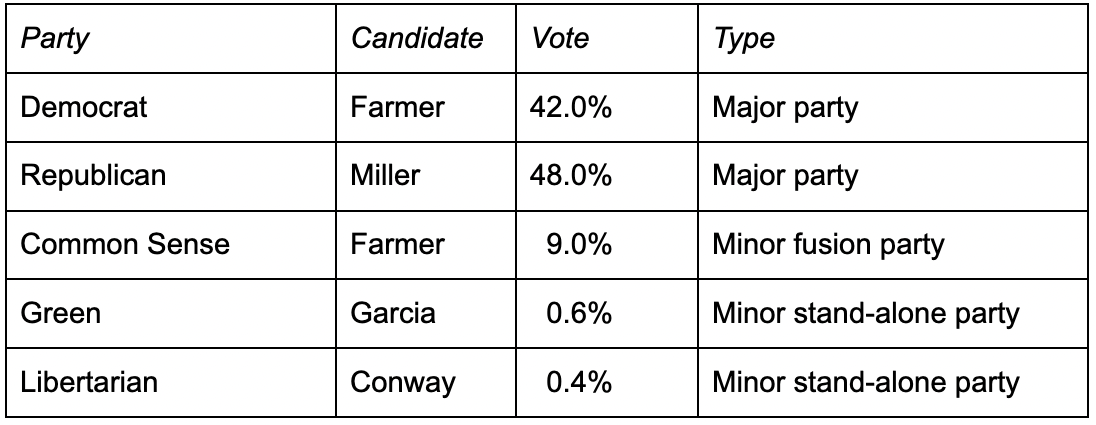
The 9% that Farmer receives on the fusion party line is added to the 42% that she receives on the major party line, producing a 51%-48% win over Miller. Because these totals are a matter of public record, Farmer knows exactly how many votes the fusion party delivered, and that these votes were critical to her victory. This creates an ongoing relationship with the minor party and gives them genuine power and influence.
What would a ballot look like?
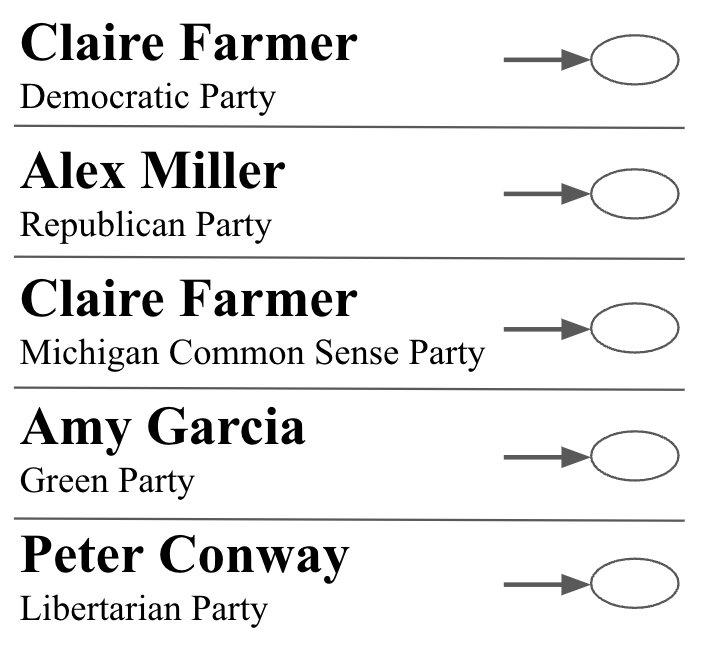
Since candidates are listed by the office they are running for, a ballot where the Michigan Common Sense Party fuses with a Democratic candidate would look like this:
Why is fusion voting the right reform for our era?
All throughout the 19th century, fusion parties typically arose on the flanks of the major parties. For example, people who opposed slavery who did not feel at home in either of the major parties, which were both largely pro-slavery before the Civil War, formed the Liberty, Free Soil, and Anti-Nebraska parties. They then fused with the Whigs and sometimes the Democrats to support anti-slavery candidates. Eventually the Whigs collapsed and the abolitionist fusion parties coalesced into a newly formed major party – the Republican Party.
After the Civil War, new parties continued to form and fuse with major party candidates, both Democrats and Republicans, to advocate for crucial issues – like reducing farmers’ debt burdens, expanding the right to vote to women, ending child labor, enacting the eight-hour work day, Prohibition, regulating banking and railroad monopolists, the direct election of US Senators – that were not getting attention from the two major parties (now Democratic and Republican).
All throughout these years, America had a vibrant multi-party system in which minor parties promoted important issues, constructively organized voters, and bargained with major party candidates in return for important policy changes. Unfortunately, the major parties eventually decided that rather than compete with the smaller parties for voters’ allegiances, they would legislate them out of existence by banning fusion voting. Today fusion remains legal and common in only Connecticut and New York.
Today’s political landscape is ripe for the revival of fusion balloting because, once again, the two-party duopoly is failing the nation and will not self-correct. In the 21st century, however, it is not primarily voters on the far-right or far-left who are politically homeless, but centrist-minded voters, especially on the GOP side of the aisle. But if such voters created a new party under the current rules that limit them to backing “stand-alone” candidates, this would be a self-defeating strategy. It could only divert votes from viable major party candidates and “spoil” races. Re-legalizing fusion will change all that.
How will the party decide which candidates to fuse with?
Rather than run our own candidates, the leaders and members of the Common Sense Party will interview the major party candidates running and then nominate the one closest to our values. We will not nominate a candidate without their agreement.
Let’s say, for example, that in one swing congressional district, an extremist wins the Republican nomination and a moderate wins the Democratic nomination. The Common Sense Party would also nominate the Democrat, who would then be listed on two different ballot lines. The party would then promote that candidate with a clear message to swing voters:
“We have evaluated the two major party Congressional candidates in this district on their commitment to bipartisanship, civility and the rule of law. And we’re recommending you vote for Claire Farmer. She’s a Democrat, and we are mostly Republicans and independents, but on those issues she’s the far better candidate. If you agree that these values are critically important these days, we urge you to vote for her on the Common Sense Party line. It counts the same as a vote on a major party line, but this way you are letting her know that these values matter to you.”
Assuming Farmer wins with the Common Sense Party helping produce her margin of victory, we’ll have some sway with her once she takes office. She’ll still be attentive to her own “home” party, but she’ll also be attentive to people like us in the center. And we’ll send a loud-and-clear message to far-right Republicans that they can’t win without the Common Sense Party’s support.
If fusion voting is legal again in Michigan, won’t it lead to lots of fringe parties?
It’s important to remember that fusion voting is voluntary. A party can’t nominate someone unless they accept the nomination. So if the Ku Klux Klan starts a party and tries to give their endorsement to someone from a major party, the candidate can just reject the nomination and it will not appear on the ballot.
Finally, it’s not that easy to qualify a new party in Michigan. State law requires a minimum of 44,620 valid signatures (one percent of the total votes cast for governor) to be collected in no more than six months, and at least 100 signatures must come from each of at least half of the state’s congressional districts.